On June 25, 1876, Lieutenant Colonel George Armstrong Custer led the 7th Cavalry against a great camp of Lakota, Northern Cheyenne and Arapaho families along the Little Bighorn River in Montana, the river the Lakota call the Greasy Grass. By the end of the day, Custer and every soldier in the five companies with him were dead. In all, 268 men on the U.S. side were killed, including several Crow and Arikara scouts.
The battle has been studied for nearly 150 years by soldiers, historians, archaeologists and the descendants of the warriors who fought there. Yet some of its biggest questions have never been fully answered. Here are 10 of them.
1. Who Really Killed Custer?
When soldiers found Custer’s body two days later, he had two gunshot wounds: one in the left side of his chest and one in his left temple. Either one would have been fatal. No one knows which came first, or who fired them.
The accounts don’t agree. In 2005, Northern Cheyenne storytellers publicly shared their tribe’s oral history that a Cheyenne woman named Buffalo Calf Road Woman struck the blow that knocked Custer from his horse. Pretty Shield, the wife of the Crow scout Goes Ahead, said Custer died in the water of the Little Bighorn, killed by a Lakota man called Big Nose. Some Lakota oral histories even claimed he ended his own life to avoid capture, though Custer was right-handed and the head wound was on his left side.
Many warriors were fighting in the dust and smoke that day, and the question may never be settled.
2. Why Did Custer Attack Without Waiting?
On the morning of June 25, Custer decided to attack at once rather than wait.
According to accounts, Custer had heard that warriors had spotted his troops’ trail, and he feared the village would scatter before he could strike. He divided his 12 companies into three groups, sending Major Marcus Reno to attack the village from the south and Captain Frederick Benteen off to scout the hills, while he led five companies himself.
His own scouts had warned him. His guide and interpreter, Mitch Bouyer, reportedly told him: “General, I have been with these Indians for 30 years, and this is the largest village I have ever heard of.” The Crow scout Half Yellow Face is said to have told Custer, through Bouyer, “You and I are going home today by a road we do not know.”
Whether Custer was reckless, overconfident or simply working with bad information is still argued about today. The Army had estimated it would face no more than about 800 warriors.
3. The Message That Came Too Late
As Custer rode north toward the village, he sent a trumpeter, John Martin, an Italian immigrant born Giovanni Martino, racing back with a hurried note for Captain Benteen. It read:
“Benteen. Come on, Big Village, Be quick, Bring packs. P.S. Bring Packs.”
When Benteen reached the area, he found Major Reno’s men retreating onto a hilltop after their own failed attack. Even though the troops could hear heavy gunfire from the north, Benteen stayed to reinforce Reno instead of riding on to Custer.
Could Benteen and Reno have saved Custer if they had pushed on? Historians have debated it for a century and a half.
Also read: 4 Native American Women Who Fought Custer At The Little Bighorn
4. Two Dozen Soldiers Who Were Never Found
Two days after the battle, burial parties found more than two dozen dead soldiers in a steep gully now called Deep Ravine. They were believed to be men of Company E, and they were hastily buried where they lay.
Within a few years, the exact spot was lost under brush and eroding soil. No one ever moved the remains to the memorial on the hill. Archaeologists later searched the ravine with modern methods, but the remains of about 24 soldiers have still never been recovered. Their resting place is one of the battlefield’s most stubborn mysteries.
5. More Grave Markers Than Men
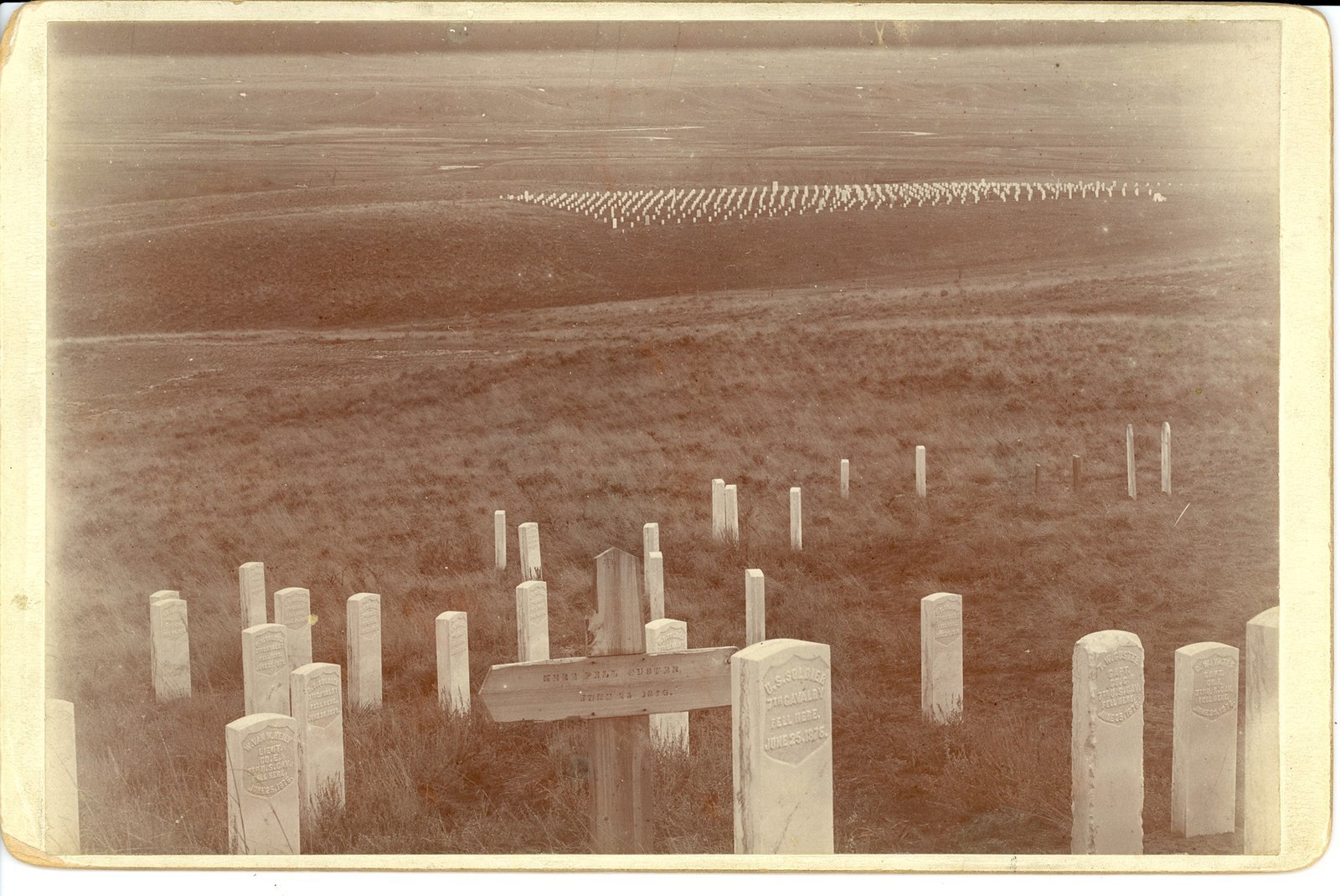
Walk the battlefield today and you’ll see white marble markers scattered across the hills, each meant to show where a soldier fell. But there are 242 of them for the roughly 210 soldiers who died with Custer’s command.
When the markers were placed in 1890, crews sometimes set two side by side where they believed two men had been buried, even when the grave held only one. Others were placed by guesswork. Archaeologists have since worked out which markers are probably wrong, but the extra stones remain, a reminder of how much was lost in the chaos after the battle.
6. Was There Really A “Last Stand”?
For more than a century, paintings and films showed Custer standing tall in a tight circle of soldiers, fighting to the last bullet. Then, on August 10, 1983, a grass fire swept across nearly 600 acres of the battlefield and burned away the thick vegetation.
Archaeologists Douglas D. Scott and Richard A. Fox Jr. saw their chance. In 1984 and 1985 they led systematic surveys, and they recovered more than a thousand artifacts: bullets, cartridge cases, arrowheads, buttons and more. Using ballistic analysis, they identified dozens of individual guns used in the battle, by soldiers and warriors alike, and tracked where they were fired.
The evidence pointed out what Scott’s work called “glaring inaccuracies” in the traditional story. Rather than a long, heroic last stand, many researchers now believe the soldiers’ positions broke down quickly under pressure from many directions. Exactly how the final minutes unfolded is still debated.
7. How Many Warriors Were There?
The Army expected to face a few hundred warriors. Instead, Custer rode into one of the largest gatherings of Plains nations ever recorded.
No one counted, and estimates vary enormously. Some historians put the number of warriors at around 1,000 to 1,100. Others say 1,800 to 2,500, and a few have suggested 3,000 or more. Warriors who were there gave estimates of their own. The true number will probably never be known.
Also read: Curly, The Crow Scout, And His Disturbing Account Of Custer’s Last Stand
8. How Many Native Warriors Died, And Why Were They Forgotten?
The names of the soldiers who died are carved in stone. The warriors who died defending their families were left out of the battlefield’s story for more than a century.
Estimates of Native losses range from about 31 to 100 killed. The Cheyenne lost seven warriors, including the respected chief Lame White Man, and the National Park Service notes there was no victory celebration that night, “for too many Cheyenne families were mourning.”
In 1925, Lame White Man’s daughter wrote to the battlefield’s superintendent asking for a marker where her father had fallen. Her request went unanswered for decades. The first red granite markers for Native warriors, for Lame White Man and the Cheyenne warrior Noisy Walking, were finally placed on Memorial Day in 1999. In 2003, an Indian Memorial honoring the nations who fought there was dedicated on the battlefield.
9. Comanche, The “Only Survivor”
For generations, Americans heard that the only survivor of Custer’s command was a horse named Comanche, the mount of Captain Myles Keogh. He was found badly wounded two days after the battle, nursed back to health, and given a place of honor. In 1878, the Army ordered that he never be ridden again.
But Comanche was not the only survivor. Historian Evan S. Connell noted that “quite a few Seventh Cavalry mounts survived, probably more than one hundred.” Most were taken by the warriors as the spoils of victory, so Comanche became the one Americans remembered. He died in 1891 and is still on display at the University of Kansas Natural History Museum.
10. The Men Who Claimed To Be “The Sole Survivor”
No soldier who rode with Custer’s five companies into that final fight is known to have survived. That didn’t stop people from claiming otherwise.
For decades after 1876, men across the country stepped forward saying they were the last survivor of Custer’s command. Custer historian E. A. Brininstool tracked more than 70 such claims, and none of them held up. Others claimed to be Custer’s last messenger or scout.
One claim still divides researchers. In 1920, a farmer named Frank Finkel said at a Rotary Club meeting that he had served with Custer at the Little Bighorn. Some of the details he gave seemed like things only a survivor would know, but his story also has inconsistencies, and historians still disagree about whether to believe him.
The Battle That Never Ends
The Battle of the Little Bighorn lasted only part of a single afternoon. But for the Lakota, Cheyenne and Arapaho people, it was the day they defended their families and their way of life, and their descendants still tell its story. For historians, archaeologists and visitors, it remains one of the most argued-over days in American history.
Today the site is the Little Bighorn Battlefield National Monument in Montana, where the white soldier markers and the red granite warrior markers stand on the same hills.
After reading about the mysteries of the Little Bighorn, learn the story of Buffalo Calf Road Woman, the Cheyenne woman who, according to her people, struck Custer down.
Related Stories
- Charles Windolph’s Shocking Account Of Custer’s Last Stand
- Private Peter Thompson’s Strange Account Of Custer’s Last Moments
- Rain-in-the-Face: The Lakota Warrior A Famous Poem Accused Of Killing Custer
- 10 Battles Where Native Nations Defeated The Spanish Empire
- What Happened To Crazy Horse’s Body? The Secret His Family Kept