Most people know Pocahontas from a movie. She meets a handsome English captain, saves his life, and falls in love.
The historical record is very different. It begins with a girl who was about ten years old when the English arrived, and it ends with a woman who died in a strange country at about 21. In between, she was kidnapped, converted, married and put on display. Historians still argue about how much of it she chose.
Who Was Pocahontas?
She was born around 1596 in the Powhatan Confederacy, a group of Algonquian-speaking peoples in what is now Virginia. Her father was Wahunsenacawh, also called Powhatan, who ruled the confederacy. Her own names were Amonute and Matoaka. “Pocahontas” was a childhood nickname, which the colonist William Strachey translated as “little wanton,” roughly meaning playful or mischievous.
The Story Of John Smith
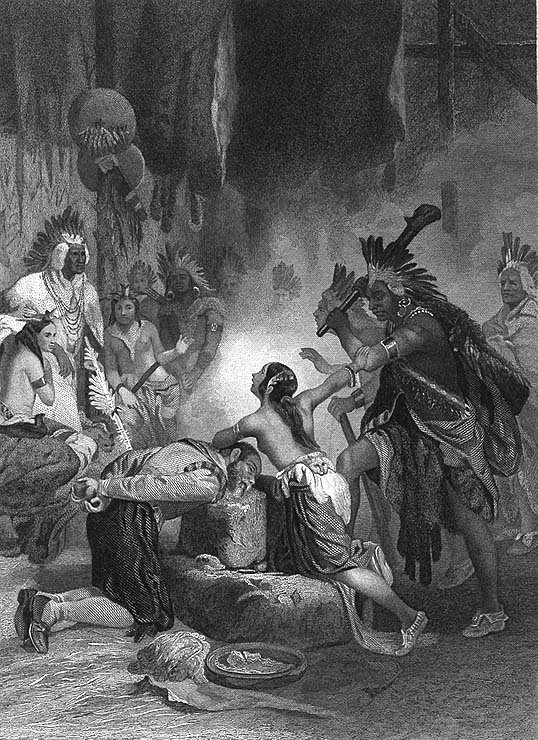
The most famous story about her is that she threw herself over the body of Captain John Smith to stop her father’s men from killing him. But Smith’s first account of his capture, written in 1608, does not mention her. He told the story in 1616 and again in 1624, long after she had become famous in England.
Smith himself wrote that she was “a child of ten years old” when they met. Historians disagree about the story. Karen Kupperman argues that Smith embellished it. Frederic Gleach believes it may describe a real ritual that Smith misunderstood. No romance between the two is supported by any record from the time. The idea first appeared in a book published in 1803.
The Kidnapping
In March 1613, during a time of conflict between the English and the Powhatan, Captain Samuel Argall learned that Pocahontas was staying with the Patawomeck leader Japazaws, a Powhatan ally. Argall pressured Japazaws, who lured her aboard Argall’s ship, the Treasurer. She was held as a hostage. The English wanted her father to return English prisoners and stolen tools and weapons.
She was about 17. She was taken to the English settlement of Henricus, where she was held for about a year.
Baptized In Captivity
During her captivity, the minister Alexander Whitaker taught her English and Christianity. She was baptized and given the name Rebecca.
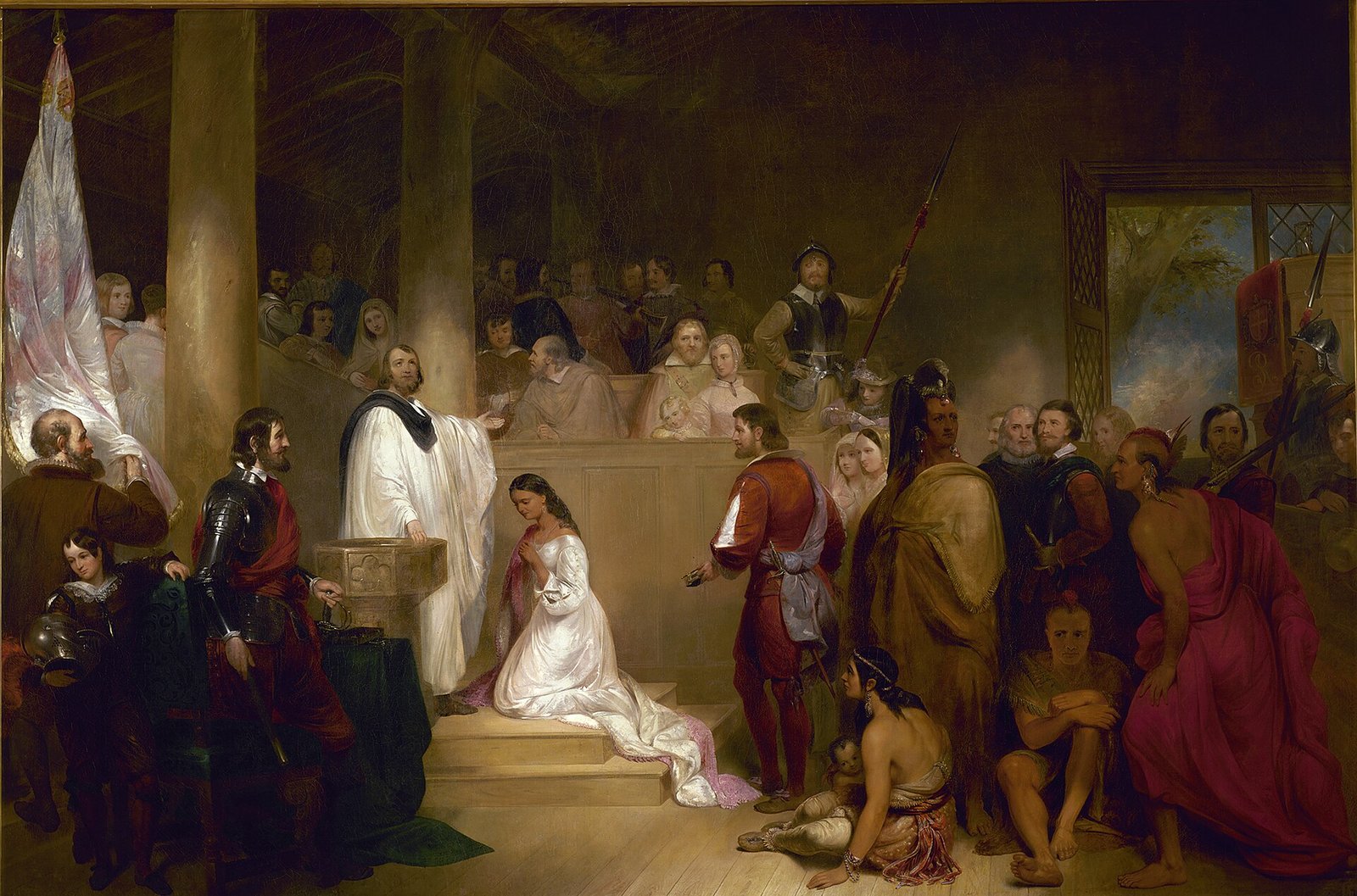
Nearly every written record about her captivity was written by English colonists. According to Mattaponi oral tradition, she was mistreated while held, but the historian Helen Rountree disputes that the tradition survived. The truth is not fully known, and that uncertainty is part of why her story remains so debated.
Marriage And Peace
On April 5, 1614, she married John Rolfe, a tobacco planter. She was about 17 or 18. Their son, Thomas, was born in January 1615. The marriage brought a period of peace between the English and the Powhatan that is sometimes called the “Peace of Pocahontas.”
A Living Advertisement
In 1616, the Virginia Company, which ran the Jamestown colony, took Pocahontas, John Rolfe and their baby to England. The company needed money and investors. It presented her as proof that its mission was working, that a Native woman could be converted, married and made “civilized.”
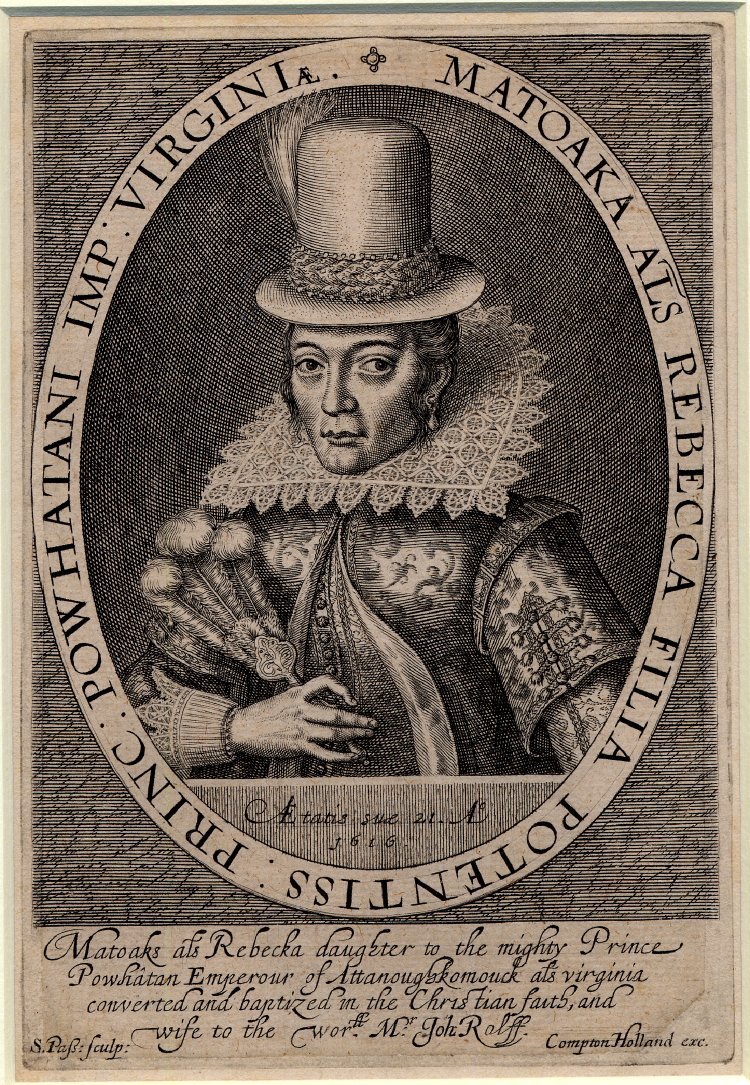
In London she was treated as a celebrity. She was received by King James I and Queen Anne, including at a performance of a Ben Jonson masque in January 1617. Crowds came to see her. An engraving of her was published, and it was inscribed “Matoaka als Rebecca,” calling her the daughter of a powerful prince.
Historians point out, though, that “princess” is an English title. The Powhatan did not use it, and the historian Helen Rountree says there is no contemporary evidence that the English really treated her as royalty.
The Last Months
In early 1617, John Smith visited the couple in England. According to Smith, Pocahontas scolded him for not honoring her as a king’s daughter.
In March 1617, as the family prepared to sail home, Pocahontas became gravely ill at Gravesend on the River Thames and died there. She was about 20 or 21. According to John Rolfe, she said that “all must die,” and that it was enough that her child lived.
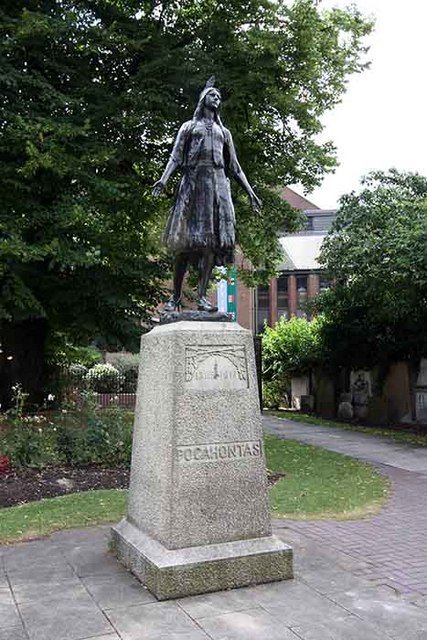
The cause of death is unknown. Historians have suggested pneumonia, smallpox, tuberculosis, a form of dysentery and poisoning. Rountree thinks dysentery with bleeding is the most likely. She was buried on March 21, 1617, at St. George’s Church in Gravesend. The church burned down in 1727, so the exact place of her grave is lost.
Princess Or Prisoner?
Was Pocahontas a willing bridge between two worlds, or a young woman used by powerful men? Historians do not agree, and there may be no single answer. She was a capable, observant person who clearly had a voice, and she lived through events that she did not control. Both things can be true.
What can be said is this: she was taken from her family by force, she lived the rest of her short life among the English, and her name has been used by others ever since. Her story is real, and it is harder than the movie.
The next time someone tells you Pocahontas was a love story, ask who wrote that version.
Related Stories
- 10 Powerful Quotes From Native American Leaders, And What Was Happening When They Said Them
- Lincoln, Grant, Sherman And Custer: 4 American Heroes And The Records Textbooks Skip
- Were The Apache Black? The Claim, The Facts, And What Old Photographs Really Show
- 4 Native American Women Who Fought Custer At The Little Bighorn
- Wooden Leg’s Disturbing Account Of Custer’s Last Stand